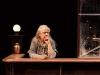
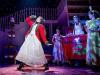
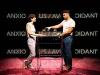
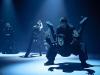
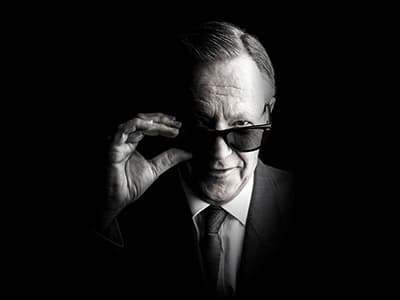
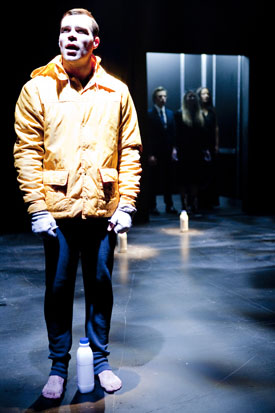
 Left - Brett Stiller. Cover - Cameron Goodall, Tahki Saul and Brett Stiller. Photos - Brett Boardman
Ah, Aeschylus! A rather severe-looking baldy, if his bust is anything to go by, but well-known as both playwright and soldier. Putting his military distinctions, or lack thereof, to one side, he is accredited as the big daddy of tragedy. He also singlehandedly reinvented drama as we know it: until this ancient Greek happened along, characters only interacted with the chorus. (Looks like a funny thing happened on the way to the Parthenon.) Scholars contend he penned anything up to around ninety plays, which would make him almost as prolific as Ayckbourn, Enright, or Williamson.
The Oresteia is the only play that has survived, holus-bolus, even among all those that have made the long, arduous journey down through the ravages of time from either he or his contemporaries, Sophocles and Euripides. Well, ok, a few lines are missing, but who can quibble? Especially given it was written almost half a millennium before that celebrated bloke from Bethlehem was found, away in a manger, no crib for a bed.
It's a trilogy, but Tom Wright's new adaptation is derived, essentially, from the first two plays. In the first, Agamemnon, the king of Argos, relates his death, at the hands of his wife, Clytemnestra. Poor Aggo, you might think, but bear in mind he did sacrifice their daughter and keep a mistress, Cassandra. That's more than enough to fire the ire of many a woman, with or without their period. The aggro Mrs Aggo, of course, takes the time to knock-off Cassie while she's at it. It's not exactly a barrel full of laughs, but one can't help but be blackly amused that Agamemnon should survive the formidable horrors of the Trojan war, only to return home to face cold-blooded, or perhaps hot-blooded, murder.
I'm being provocative as a way of introducing Wright's self-confessed obsession with examining the patriarchical and carelessly mysoginistic bent of the texts. He certainly succeeds in bringing this to the fore, in all its Freudian excess. Nowhere is this more starkly evident than in a speech by Apollo towards the end of the second play, The Libation Bearers, in which he underscores the father as the only true parent and mother as mere vessel. This, of course, met with peals of laughter from the opening-night audience, and might've been funny, if only it hadn't been so serious, way back when. Wright had the good sense to ridicule the speech by having it played, by Cameron Goodall, with exaggerated solemnity.
Alice Babidge's stark design, with the interpolation of three lifts, to deliver players and screen bloody horrors, is a revelation and contributes majorly to the depth of the drama. Damien Cooper's lighting design works hand-in-glove. The irrepressible and inescapable Max Lyandvert has excelled, even by his standards, with composition and sound design. If there's a greater exponent to be found, in either capacity, I'd certainly like to meet him or her: his music is hauntingly exquisite and sound is meticulous (bar some electrical, or electronic, interference at one point). Let's not underestimate the contributions of sound operator, Bede Schofield, in production quality either. Cam Menzies must be a one helluva theatre tech, too, for everything worked on cue and was timed to a tee.
Ursula Mills was clear-as-a-Bell in her role as the Coryphaeus and fellow 'chorusters', Alice Ansara & Sophie Ross chimed. The last doubled as Electra, Agamemnon's daughter. She seemed to assume a somewhat demure, naive posture, as if to prefigure Apollo's later speech, putting women in their lowly, if useful place. If this was the goal, she achieved it; with a paradoxically knowing innocence. The question arises, of course, as to whether Electra's apparent innocence is feigned, or real, but that is to open a hornet's nest of intellectual and literary debate.
Zindzi Okenyo, in imbuing Clytemnestra not only with the passions of a lonely, jealous & wronged wife, but unbridled passions of her own, as well as the resilience and steely determination of Hillary Clinton. She is transfixing.
By contrast, Tahki Saul's Agamemnon, despite his boldness in battle and shameless swagger in bringing his mistress into the marital home, appears to be played (brilliantly, as it happens) as something of a cuckold. Maybe Wright was looking to suggest tension between the decrees of Apollo and reality on the ground. If so, it works for me.
Julia Ohanessian joins the chorus later and also doubles as the irresistible Cassandra, who not even Apollo could resist. Ohanessian, also, was sterling. Richard Pyros delivers a delightfully amusing performance (all the light relief we can get out of this otherwise quite leaden, laden drama is welcome) as the effete, ambisexually predatory, cowardly fop, Aegisthus, more the concubine of Clytemnestra than she of him. His reading seemed to validate my suspicion that Wright is making a concerted attempt to emasculate these mythological manboys in order to discredit a vacuous, chauvanistic, sociopolitical apartheid that's still with us, notwithstanding all efforts to exterminate it. Finally, Brett Stiller's Orestes appears in cahoots as, even in showing some resolve and steadfastness in avenging his father's murder, succumbs to infantile temptations, gravitating incestuously towards both his mother and sister. To further complicate and confound matters, as well as arouse the amateur psychoanalyst in us all, his weakness for such is readily embraced and reciprocated; one of the most powerful scenes (other than the murderous ones, which are enough to render even Scorsese queasy) is the bush-in-your-face, confrontingly cunnilingual encounter between Orestes and Clytemnestra. But wait, there's more.
The Oresteia got a gong at the Dionysus festival, way back in 458 BC. Tom Wright & The Residents' takes deserves another. In fact, STC's Residents deserve a lifetime lease.
Oresteia. Oedipal. Electrafied. Dramatic, in excelsis. Comedic. It is a beguiling work of performance art & craft.
Sydney Theatre Company presents
Oresteia
by Aeschylus, in a new adaptation by Tom Wright
Director Tom Wright
Venue: Wharf 1, Sydney Theatre Company, Pier 4 Hickson Rd, Walsh Bay
Dates: 1 June - 4 July, 2010
Tickets: $30 - $75 (transaction fees may apply)
Bookings: 9250 1777 | www.sydneytheatre.com.au